Home
Performance
News
About

中
EN
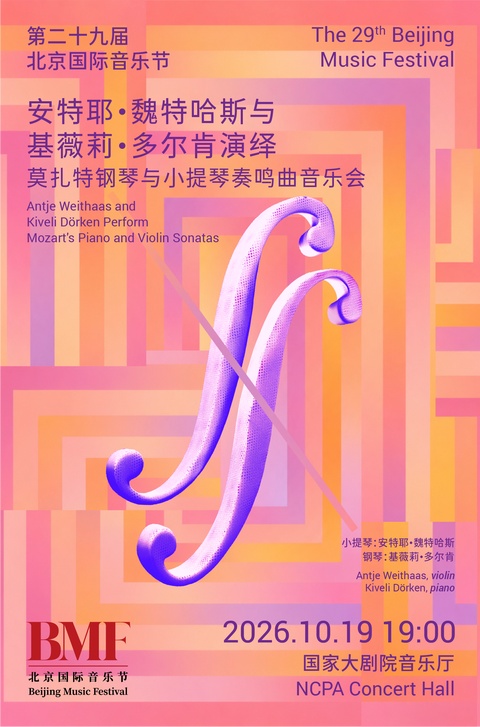
Bows and Keys Converse · Two Voices Harmonize
Show Details
Bows and Keys Converse · Two Voices Harmonize
Antje Weithaas and Kiveli Dörken Perform Mozart's Sonatas for Piano and Violin
19:00 · Monday, October 19, 2026 · NCPA Concert Hall
Antje Weithaas, violin · Kiveli Dörken, piano
Keys and bow: a dialogue of equals
Highlights
In Mozart's day there was no such thing as the “violin sonata” as we know it. Such works were published as sonatas “for keyboard, with violin accompaniment”: the piano ruled absolutely; the violin added ornament. It was Mozart — master of both instruments from childhood — who transformed the genre, step by step freeing the violin from its subordinate role until it stood as the piano's equal in conversation. Hence tonight's theme: the equal dialogue of keys and bow begins with Mozart.
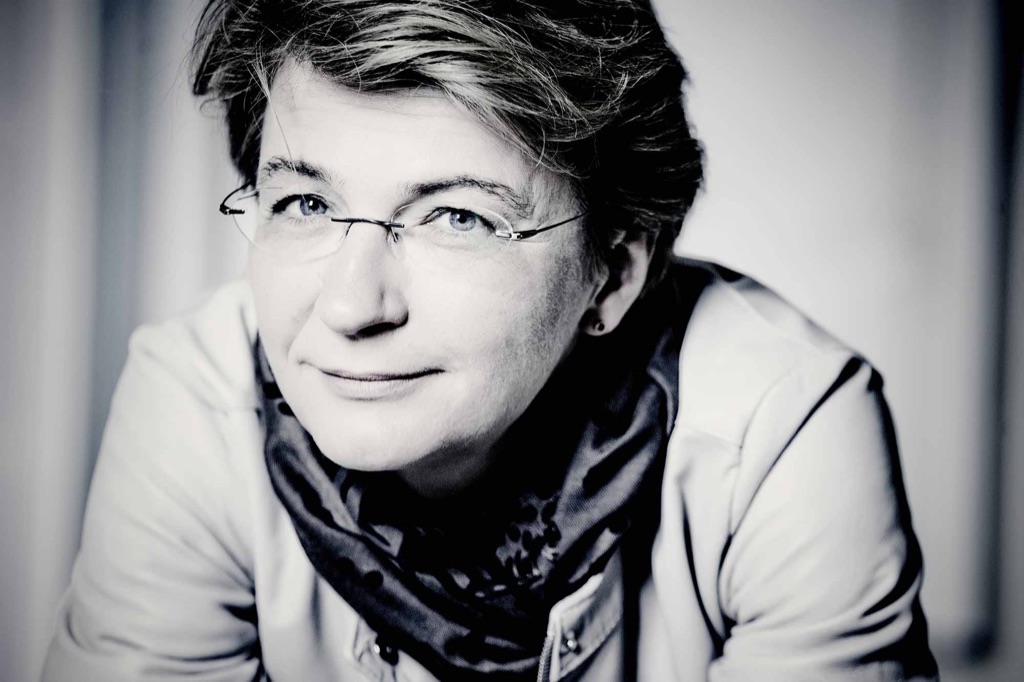 Antje Weithaas|violin
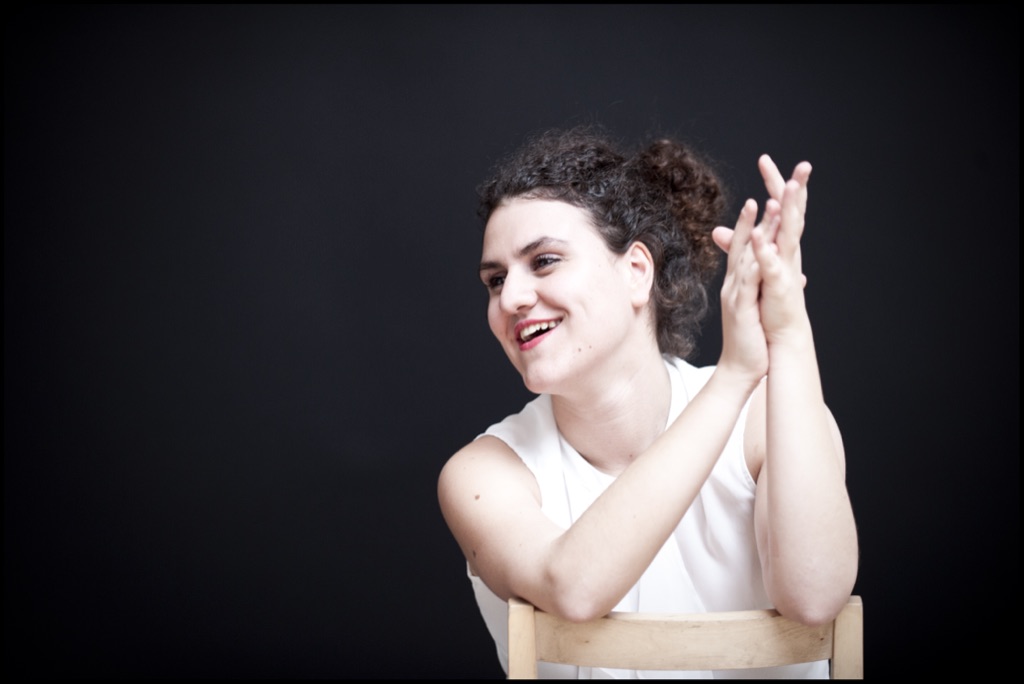 Kiveli Dörken|piano
A second dialogue belongs to tonight's artists. Antje Weithaas is among Germany's most revered violinists and teachers, prized for stylistic purity and an inward, deeply considered expressiveness; her partner Kiveli Dörken is one of Europe's most closely watched pianists. Mozart's duo sonatas look limpid and simple; in truth they demand of two players an exacting unity of ensemble, proportion and taste — one ounce of display or imbalance, and the natural grace is gone. This partnership is ideally suited to them.
Among the nine sonatas are featherlight salon pieces of the early years and deeply felt masterworks of maturity — above all the E minor Sonata, the only one Mozart wrote in the minor, believed to be bound up with his mother's death in Paris: two short movements with tears in every phrase, the rawest grief this famously sunny composer ever allowed onto the page. Tonight, listen as violin and piano hear, answer and enfold one another — and, in the plainest of mediums, speak Mozart's most honest heart.
Spanning roughly a decade, the nine sonatas let the listener trace the composer's growth — and the violin's quiet rise. K. 301–305, written in Mannheim and Paris in 1778 and dedicated to the Electress of the Palatinate, mark the genre's coming of age, though the violin still often defers politely to the keyboard; K. 376 and K. 379, from his first Viennese years, are more refined still; and in the late masterpieces K. 454 and K. 526 the two instruments stand fully matched, phrase for phrase — music that holds its own even amid the riches of Mozart's final decade.
Program Notes
Sonata for Piano and Violin No. 18 in G major, K. 301
The first of the 1778 “Palatine” sonatas opens the set in radiant G major: two movements only, concise and finely made. Violin and piano are no longer master and servant but friends in easy exchange, the melodies flowing with youthful brightness and salon elegance.
Sonata for Piano and Violin No. 19 in E-flat major, K. 302
Also from 1778, K. 302 unfolds in serene E-flat major, warm and expansive. A broadly singing first movement is followed by a graceful rondo of the lightest step, the two instruments answering each other turn by turn — Mozart's ear for balance at its most refined.
Sonata for Piano and Violin No. 20 in C major, K. 303
The originality of K. 303 lies in its first movement, where a slow introduction and a lively Allegro alternate throughout — novel in form, dramatic in effect. Compact, bright and quick-witted, it shows the young Mozart's appetite for experiment.
Sonata for Piano and Violin No. 21 in E minor, K. 304
The only minor-key work among all Mozart's violin sonatas, and the most profound. It was written in Paris in 1778, around the time of his beloved mother's death there, and unnameable grief and loneliness shadow it throughout. Two movements only: the first surging darkly beneath its restraint; the second a plaintive minuet whose brief major-key episode offers one ray of consolation before the sorrow closes in again. Barely a dozen minutes of music, every phrase close to tears — by common consent among the most moving chamber works Mozart ever wrote.
Sonata for Piano and Violin No. 22 in A major, K. 305
K. 305 returns to open skies: warm, luminous A major, brimming with vitality. The finale is a set of variations in which a simple theme is dressed in ever richer invention, violin and piano trading the lead — the pure joy of music-making.
Sonata for Piano and Violin No. 24 in F major, K. 376
Written after Mozart settled in Vienna in 1781, and part of a set dedicated to his pupil Josepha Auernhammer, K. 376 shows the composer in fully assured stride: a confident, open-hearted first movement, a gently singing slow movement, and a quick, humorous finale aglow with the ease and polish of his Viennese years.
Sonata for Piano and Violin No. 27 in G major, K. 379
K. 379 is built on striking contrasts: a broad, deeply felt slow introduction gives way to a stormy G minor Allegro; the finale is a set of graceful variations. Mozart reportedly wrote the piece overnight before a performance — setting down only the violin part and playing the piano from memory — yet nothing in its beauty or its craftsmanship betrays the haste.
Sonata for Piano and Violin No. 32 in B-flat major, K. 454
Composed in 1784 for the visiting Italian virtuosa Regina Strinasacchi, K. 454 marks the duo sonata's full maturity. Here the violin at last stands wholly equal to the piano, their dialogue grand in gesture and rich in feeling. From the solemn slow introduction, through the songful Andante, to the dancing finale, it is — in all but name — a double concerto.
Sonata for Piano and Violin No. 35 in A major, K. 526
Written in 1787, K. 526 is the crown of Mozart's late duo sonatas, often called the summit of the genre. The two instruments move as one through counterpoint of wonderful finesse and intimacy; technique and feeling stand in perfect equilibrium. A buoyant first movement, a deep and searching slow movement, and a finale of unstoppable quicksilver momentum bring the sonata — and tonight's whole survey — to a dazzling close: the highest tribute to the art of “two voices in harmony.”
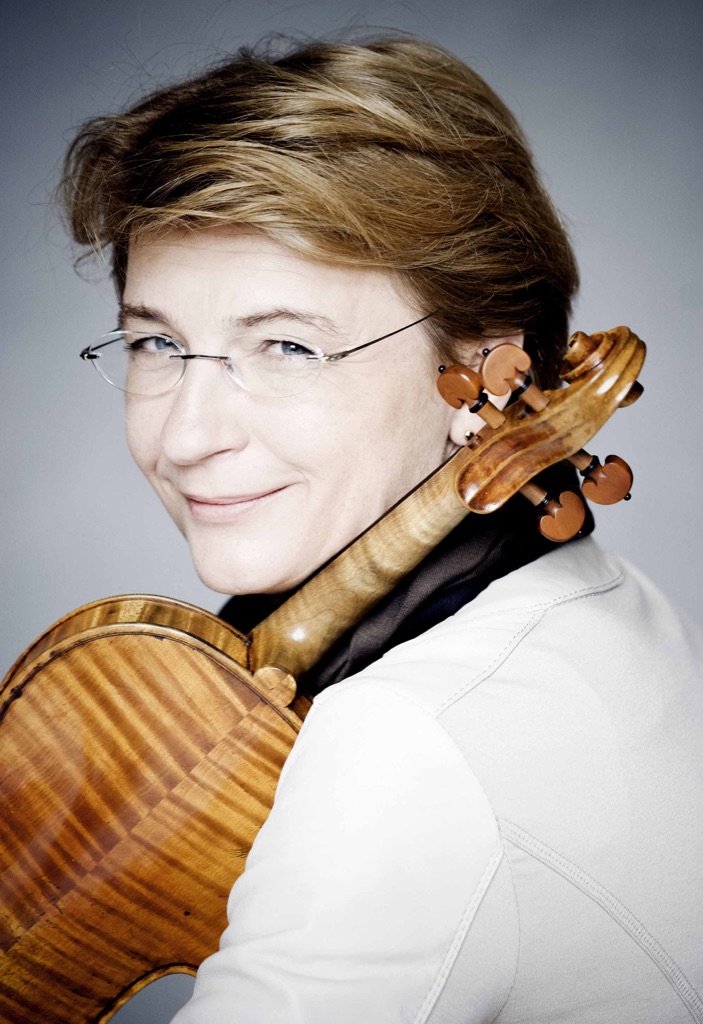
Antje Weithaas|Violin
Brimful of energy, Antje Weithaas brings compelling musical intelligence and technical mastery to every detail of the music. Her charisma and stage presence are captivating, but never overshadow the works themselves. Her wide-ranging repertoire includes the great concertos of Mozart, Beethoven and Schumann, Jörg Widmann’s Violin Concerto, modern classics by Shostakovich, Prokofiev, Ligeti and Gubaidulina, and lesser-performed concertos by Hartmann and Schoeck.
As a soloist, Weithaas has worked with leading orchestras including the Deutsches Symphonie-Orchester Berlin, Bamberg Symphony, the major German radio orchestras, Los Angeles Philharmonic, San Francisco Symphony, Philharmonia Orchestra and BBC Symphony Orchestra. She has collaborated with conductors including Vladimir Ashkenazy, Dmitri Kitayenko, Sir Neville Marriner, Marc Albrecht, Yakov Kreizberg, Sakari Oramo and Carlos Kalmar.
Through her infectious zest for communication and leadership, Weithaas is highly regarded for inspiring play-conducted concerto performances with renowned chamber orchestras. She served as Artistic Director of Camerata Bern for almost ten years, shaping the ensemble’s artistic profile and leading large-scale works including Beethoven’s symphonies. She was also artiste associé of the Orchestre de Chambre de Paris and helped initiate its play-conducting academy.
Her discography includes the complete solo sonatas and partitas of Bach and the solo sonatas of Ysaÿe, the complete Beethoven Sonatas for Piano and Violin, the complete works for violin and orchestra by Bruch, and Vasks’s Violin Concerto No. 2 “In Evening Light”. Her Beethoven sonata recording with pianist Dénes Várjon received the German Record Critics’ Annual Award, while her Vasks album with Camerata Bern was named “Instrumentalist of the Year” at the 2025 Opus Klassik Awards.
Weithaas began playing the violin at the age of four and later studied with Professor Werner Scholz at the Hochschule für Musik “Hanns Eisler” Berlin. She won prizes at the Kreisler Competition in Graz, the Bach Competition in Leipzig and the Joseph Joachim International Violin Competition in Hanover. Since 2019, she has shared the artistic leadership of the Joachim Competition with violinist Oliver Wille. She became Professor of Violin at the Hochschule für Musik “Hanns Eisler” in 2004 and plays a 2001 Peter Greiner violin.
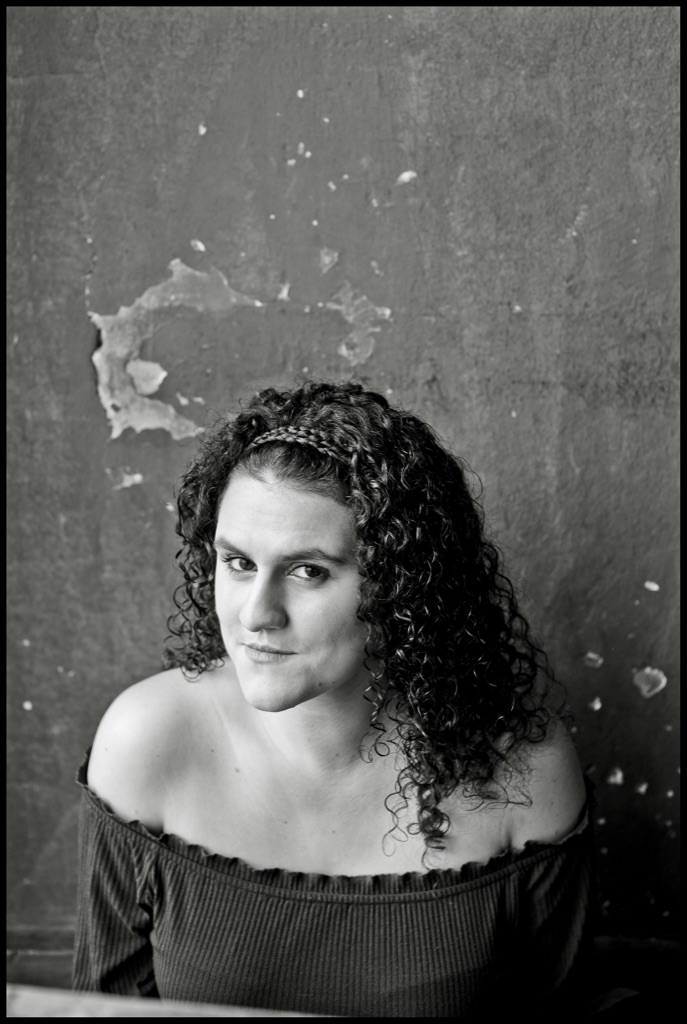
Kiveli Dörken|Piano
Kiveli Dörken’s musical temperament, passion and dedication are palpable in every concert. With her infectious enthusiasm and captivating stage presence, she values a close connection with her audience and continually explores the richness of sound and the boundaries of artistic expression.
Kiveli began her musical education at the age of seven with the renowned piano pedagogue Professor Karl-Heinz Kämmerling, who taught her for ten years. She subsequently continued her studies with Professor Lars Vogt at the Hochschule für Musik, Theater und Medien in Hanover.
At the age of eight, she gave her orchestral debut. Since then, she has performed as a soloist with orchestras including the Hamburger Camerata, Camerata Bern, the Athens State Orchestra and the Deutsche Kammerphilharmonie Bremen. In 2019, she made her debut with the Deutsche Kammerphilharmonie Bremen, performing César Franck’s Variations symphoniques under Alondra de la Parra. In 2025, she performed Rachmaninoff’s Piano Concerto No. 2 in the Great Hall of the Elbphilharmonie in Hamburg.
Her performances have taken her throughout Europe, China, Japan, Korea and the United States. She has appeared at major venues including the Elbphilharmonie Hamburg, the Mariinsky Theatre in St Petersburg, the Gewandhaus Leipzig, the Konzerthaus Berlin and the Alte Oper Frankfurt, and is a regular guest at festivals such as the Kissinger Sommer, the Schwetzingen Festival, the Spannungen Festival in Heimbach and the Schleswig-Holstein Musik Festival.
Kiveli dedicates considerable time to chamber music and performs regularly with artists including Christian Tetzlaff, Sharon Kam, Julian Steckel, Antje Weithaas and Tanja Tetzlaff. Since the age of five, she has performed as a piano duo with her sister Danae Dörken. She is also a member of the Franz Ensemble, whose debut recording featuring works by Ferdinand Ries received an Opus Klassik Award.
In 2015, Kiveli founded the Molyvos International Music Festival on the Greek island of Lesbos, where she serves as Artistic Director. During a period of economic hardship and refugee crisis in Greece, the festival became an important platform for classical music, community and hope. In 2020, she released her debut album with the label ARS, featuring solo and chamber works by Josef Suk.
Sonata for Piano and Violin No. 18 in G major, K. 301 14′
Sonata for Piano and Violin No. 19 in E-flat major, K. 302 14′
Sonata for Piano and Violin No. 20 in C major, K. 303 11′
Sonata for Piano and Violin No. 21 in E minor, K. 304 15′
—Intermission—
Sonata for Piano and Violin No. 22 in A major, K. 305 16′
Sonata for Piano and Violin No. 24 in F major, K. 376 17′
Sonata for Piano and Violin No. 27 in G major, K. 379 21′
—Intermission—
Sonata for Piano and Violin No. 32 in B-flat major, K. 454 23′
Sonata for Piano and Violin No. 35 in A major, K. 526 25′
Antje Weithaas, violin
Kiveli Dörken, piano
Approximate total duration: 186 mins (including 30 mins intermission)
The program is subject to change
 Wechat Video
WeChat Official Account
WeChat Mini Program
Wechat Video
WeChat Official Account
WeChat Mini Program
 Redbook
 Tiktok